

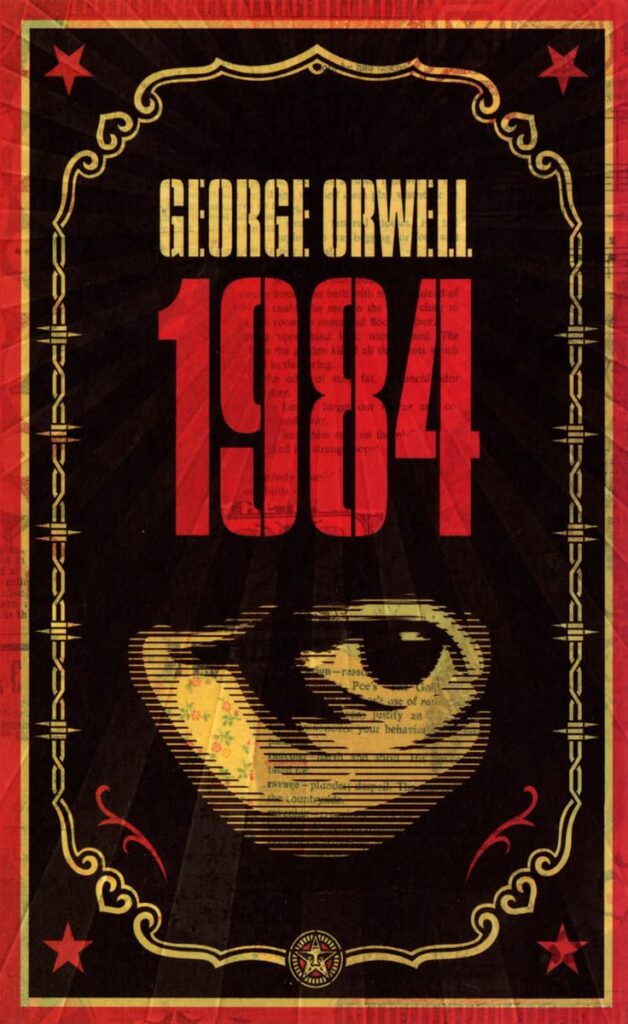
1984 Summary
✍️ About the Author: George Orwell
George Orwell remains one of the most influential political writers of the twentieth century, known for transforming complex social anxieties into unforgettable fiction. Through works like Animal Farm and 1984, Orwell explored the dangers of authoritarianism, propaganda, and unchecked power. His writing was not merely political commentary—it was a warning about what happens when truth itself becomes controlled.
Published in 1949, 1984 continues to feel disturbingly relevant because it speaks to fears that transcend time: surveillance, manipulation, censorship, and the gradual erosion of individuality.
🌑 Entering Oceania: A Society Built on Fear
The world of 1984 is cold, oppressive, and psychologically suffocating. The novel takes place in Oceania, a totalitarian state ruled by the Party under the ever-watchful figure of Big Brother. In this society, privacy no longer exists. Every movement, expression, and even thought is monitored.
“Big Brother is Watching You.”
This phrase is more than propaganda—it is the emotional atmosphere of the entire novel. Fear is constant, invisible, and deeply internalized.
Citizens are not only expected to obey the Party; they are expected to love it. Individuality becomes dangerous because independent thought itself is treated as rebellion.
🧠 Winston Smith and the Quiet Rebellion of Thought
At the center of the story is Winston Smith, an ordinary man working at the Ministry of Truth, where historical records are constantly rewritten to align with the Party’s shifting narratives. Truth is not objective in Oceania—it is manufactured.
“Who controls the past controls the future. Who controls the present controls the past.”
Winston’s rebellion begins not with violence, but with thought. In a society where language, memory, and reality are manipulated, simply questioning the system becomes an act of resistance.
What makes Winston compelling is not heroic strength, but fragile humanity. He longs for truth, intimacy, and freedom in a world designed to eliminate all three.
⚡ The Manipulation of Reality and Language
One of Orwell’s most chilling ideas is the concept of Newspeak, a language engineered to reduce the range of thought itself. By eliminating words connected to rebellion or individuality, the Party gradually makes independent thinking impossible.
“War is peace. Freedom is slavery. Ignorance is strength.”
These contradictions form the foundation of “doublethink”—the ability to hold opposing ideas simultaneously and accept both as true. Orwell shows how propaganda becomes most dangerous not when people are forced to obey, but when they lose the ability to distinguish truth from falsehood.
This manipulation extends beyond language into memory itself. If history can be rewritten endlessly, reality becomes unstable.
🌊 Love as an Act of Defiance
Winston’s relationship with Julia introduces one of the novel’s most emotional dimensions. In a world where emotional connection is discouraged and loyalty must belong only to the Party, love becomes revolutionary.
Their relationship is not merely romantic—it is an attempt to reclaim humanity itself.
“If you loved someone, you loved him, and when you had nothing else to give, you still gave him love.”
Yet Orwell never allows hope to feel secure. Even moments of intimacy exist under the shadow of surveillance and betrayal.
🔥 Power for the Sake of Power
As the novel progresses, Orwell reveals the Party’s true objective: power is not a means to an end—it is the end itself.
“If you want a picture of the future, imagine a boot stamping on a human face—forever.”
This is what makes 1984 so terrifying. The Party does not seek justice, prosperity, or even stability. It seeks absolute domination over thought, emotion, and identity.
The novel’s horror lies not in physical violence alone, but in psychological conquest—the destruction of the individual from within.
🛡️ Surveillance and the Loss of Self
Long before the digital age, Orwell envisioned a world where surveillance extends beyond observation into control. Telescreens monitor citizens constantly, but the greater danger is internalized fear. People censor themselves because they know they may always be watched.
The result is isolation. Trust disappears. Authenticity becomes impossible.
This is why 1984 remains enduringly powerful—it speaks not only about governments, but about the fragility of truth and freedom in any society where fear overrides critical thought.
✨ Why This Book Stays With You
1984 lingers long after its final page because it feels less like fiction and more like a warning. Orwell forces readers to confront uncomfortable questions about authority, media, conformity, and the value of independent thought.
“Freedom is the freedom to say that two plus two make four.”
This simple statement becomes profoundly significant in a world where reality itself can be manipulated.
The novel stays with you because it reveals how easily truth can erode when people surrender the courage to question.
🎯 Who Should Read This Book
✔️ Readers interested in political fiction and dystopian literature
✔️ Anyone fascinated by surveillance, propaganda, and power structures
✔️ Students exploring philosophy, politics, or classic literature
✔️ Those seeking thought-provoking novels with deep social relevance
💭 Final Reflection
1984 is more than a dystopian novel—it is an exploration of what happens when power seeks control not only over actions, but over reality itself. Orwell reminds us that freedom begins with the ability to think independently, to question authority, and to preserve truth even when systems attempt to distort it.
“Until they become conscious they will never rebel, and until after they have rebelled they cannot become conscious.”
And perhaps that is the novel’s deepest warning: the greatest threat to freedom is not always force, but the gradual acceptance of silence, fear, and manipulated truth.
Disclosure: This article contains affiliate links.
Explore more book summaries on Reading Axis. Book Summaries
Read the summary of Rich Dad Poor Dad https://thereadingaxis.com/rich-dad-poor-dad-summary/
Read the summary of Dopamine Detox https://thereadingaxis.com/dopamine-detox-book-summary/
Read the summary of The Alchemist https://thereadingaxis.com/the-alchemist-summary-personal-legend/
Read the summary of The Kite Runner https://thereadingaxis.com/the-kite-runner-book-summary/
Read the summary of The Vegetarian – Han Kang https://thereadingaxis.com/the-vegetarian-by-han-kang-summary/
Read A Thousand Splendid Suns – Khaled Hosseini https://thereadingaxis.com/a-thousand-splendid-suns-summary/
Read Think and Grow Rich – Napoleon Hill https://thereadingaxis.com/think-and-grow-rich-summary-laws-of-success/
Read Ego is the Enemy – Ryan Holiday https://thereadingaxis.com/ego-is-the-enemy-summary-lessons/