


Deep Work – Book Summary
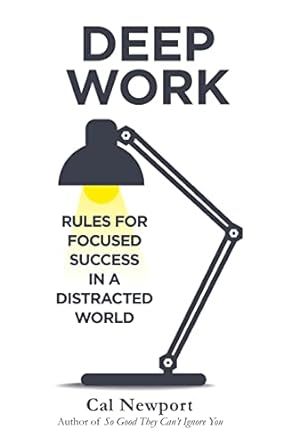
Deep work refers to professional activities performed in a state of distraction-free concentration that push your cognitive abilities to their limit. These efforts create new value, improve your skills, and produce results that are difficult to replicate.
As Cal Newport defines it:
“Deep work: Professional activities performed in a state of distraction-free concentration that push your cognitive capabilities to their limit.”
In contrast, shallow work consists of non-cognitively demanding logistical tasks—such as checking emails, attending routine meetings, and scrolling through social media. These tasks are easy to replicate and rarely create meaningful value. Unfortunately, modern work culture is increasingly dominated by shallow work, leaving little room for depth, focus, and true productivity.
Newport defines shallow work as:
“Non-cognitively demanding, logistical-style tasks, often performed while distracted.”
Cal Newport argues that the ability to perform deep work is becoming increasingly rare at the same time it is becoming increasingly valuable. As a result, those who cultivate this skill and make it central to their professional lives will thrive in the modern economy.
The author himself serves as a powerful example. After graduating from college, he published multiple books, completed his PhD, and became a professor at Georgetown University—all while maintaining strict boundaries around his time and rarely working late evenings. His success was not driven by longer hours, but by deeper focus.
Why Deep Work Is Valuable in the Modern Economy
Technology is advancing rapidly, but many skills and organizations struggle to keep pace. According to economists Erik Brynjolfsson and Andrew McAfee, technology is not eliminating all jobs—it is restructuring the economy. It favors three types of individuals:
- Those who can work effectively with intelligent machines
- Those who are the best at what they do
- Those who have access to capital
Newport explains:
“If you don’t produce, you won’t thrive—no matter how skilled or talented you are.”
This shift creates a clear reality: average skills are becoming less valuable, while elite skills are becoming more rewarded.
Two core abilities are essential in this new economy:
- The ability to quickly master hard things
- The ability to produce high-quality work at elite levels, both in speed and quality
Both abilities depend heavily on deep work.
Learning complex skills—such as programming, scientific research, or advanced analysis—requires intense concentration. Psychologist Anders Ericsson’s research on deliberate practice shows that focused attention is essential for skill development. Similarly, Daniel Coyle, in The Talent Code, explains that skill improves when neural circuits strengthen through focused repetition.
In simple terms:
High-quality work = Time spent × Intensity of focus
It is not the number of hours that matters most, but the depth of concentration during those hours.
Why Deep Work Is Becoming Rare
Despite its value, deep work is becoming increasingly rare due to modern workplace culture.
Open offices, constant notifications, instant messaging, and email create an environment of continuous distraction. Companies often promote constant connectivity, expecting employees to respond quickly to messages and emails. This creates what researchers call “attention fragmentation.”
Newport describes this dangerous trend:
“Our work culture’s shift toward the shallow is exposing a massive economic and personal opportunity for the few who recognize the potential of resisting this trend.”
Professor Gloria Mark from the University of California found that frequent interruptions reduce productivity and increase stress. Each interruption forces the brain to switch context, reducing cognitive efficiency.
Sophie Leroy’s research on “attention residue” shows that when switching tasks, part of the mind remains stuck on the previous task, reducing focus on the new one.
Social media and communication tools also create what Cal Newport calls a “culture of connectivity,” where responsiveness is valued more than meaningful productivity. This culture rewards visible activity rather than valuable output.
As a result, many professionals spend their days reacting instead of creating.
Deep Work Creates Meaning and Satisfaction
Deep work is not only economically valuable—it is psychologically fulfilling.
Psychologist Mihaly Csikszentmihalyi describes a mental state called flow, where a person becomes completely absorbed in a challenging and meaningful task. During flow, time seems to disappear, and the experience becomes deeply satisfying.
These moments represent some of the most meaningful experiences in human life.
When people focus deeply on important work, they experience:
- Greater satisfaction
- Higher productivity
- Stronger sense of purpose
- Improved skill development
As Newport explains, your world becomes shaped by what you focus on. Your attention determines your reality.
A distracted life leads to shallow satisfaction. A focused life leads to depth, mastery, and meaning.
The Four Rules of Deep Work
Cal Newport provides four practical rules for developing deep work as a habit.
Rule 1: Work Deeply
Deep work requires structure, routines, and rituals.
Willpower alone is unreliable. Research by Roy Baumeister shows that willpower is limited and becomes depleted throughout the day. Instead of relying on motivation, successful individuals build systems that support deep work.
Different deep work philosophies include:
Monastic Philosophy:
Eliminate most shallow work entirely and focus almost exclusively on deep work.
Bimodal Philosophy:
Divide time between deep work and shallow work—for example, dedicating entire days to deep work.
Rhythmic Philosophy:
Schedule deep work into daily routines, such as working deeply every morning.
Consistency strengthens the brain’s ability to focus deeply.
Creating a shutdown ritual at the end of the day is also essential. This allows the brain to rest and recover, improving performance the next day.
Downtime is not laziness—it is essential for cognitive recovery.
Rule 2: Embrace Boredom
The ability to focus is like a muscle—it must be trained.
Newport explains:
“Efforts to deepen your focus will struggle if you don’t simultaneously wean your mind from a dependence on distraction.”
Constant distractions weaken your focus. Many people instinctively reach for their phone at the first sign of boredom, training their brain to avoid deep thinking.
Instead, learn to tolerate boredom.
Practice working without distractions. Schedule periods without internet access. Allow your mind to focus deeply without interruption.
This strengthens your ability to concentrate for longer periods.
Rule 3: Quit Social Media (Selective Use)
Social media is not inherently evil, but it comes with a cost: your attention.
Many tools provide small benefits while consuming large amounts of time and mental energy.
Newport recommends evaluating each tool carefully. Ask yourself:
- Does this tool significantly support my goals?
- Does the benefit outweigh the cost of attention and time?
If not, eliminate or limit its use.
Protect your attention as a valuable resource.
Rule 4: Drain the Shallows
Shallow work will always exist, but it must be controlled.
Schedule your day into blocks and assign specific tasks to each block. This ensures that deep work receives priority.
Reduce unnecessary meetings and communications.
Make your email responses more efficient by being clear and structured.
Set boundaries around your availability.
Finish work at a defined time each day to allow proper recovery.
Conclusion: Deep Work Is a Superpower in the Modern World
Deep work is becoming increasingly rare, but it is also becoming increasingly valuable.
In a world filled with distraction, the ability to focus deeply is a competitive advantage.
It allows you to:
- Learn faster
- Produce higher-quality work
- Build valuable skills
- Achieve meaningful success
- Experience deeper satisfaction
Newport summarizes its importance powerfully:
“The deep work hypothesis: The ability to perform deep work is becoming increasingly rare and increasingly valuable.”
Deep work is not easy. It requires discipline, structure, and commitment.
But those who cultivate this skill will thrive—not only professionally, but personally.
In the modern economy, deep work is a true superpower.
Disclosure: This article contains affiliate links.
Explore more book summaries on Reading Axis. Book Summaries
Read the summary of Atomic Habits – Transform your life in 4 Laws https://thereadingaxis.com/atomic-habits-summary-4-powerful-laws-to-build-good-habits-and-break-bad-ones/
Read the summary of Psychology of Money – Timeless Lessons https://thereadingaxis.com/psychology-of-money-summary/



One thought on “Deep Work Book Summary by Cal Newport: Complete Guide to Focus and Success”