
Meditations summary
✍️ About the Author: Marcus Aurelius
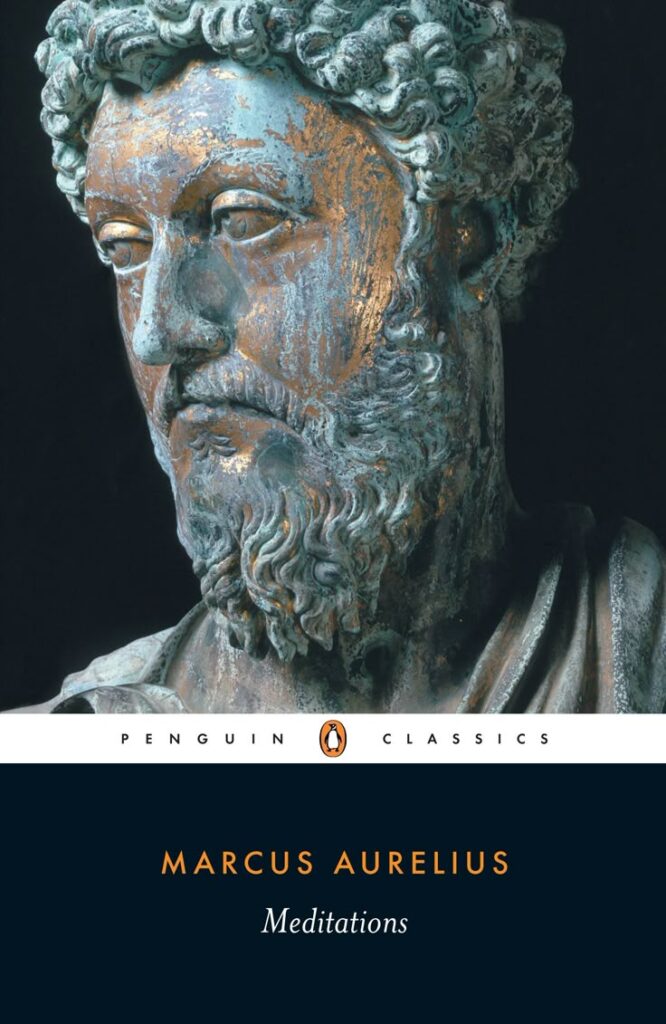
Marcus Aurelius was not merely one of history’s greatest philosophers—he was also the Roman Emperor who ruled from 161 to 180 AD during one of the most turbulent periods of the Roman Empire. Wars, political unrest, devastating plagues, and enormous responsibility surrounded his reign. Yet amidst these external storms, Marcus quietly wrote personal reflections that were never intended for publication.
Those private writings eventually became Meditations, one of the most influential philosophical works ever created.
Unlike many philosophical texts that attempt to persuade or instruct others, Meditations is deeply personal. It is a conversation Marcus Aurelius has with himself—a daily exercise in self-improvement, humility, discipline, and rational thinking. Every page reflects a man reminding himself how to remain calm while carrying the weight of an empire.
More than eighteen centuries later, these reflections continue to guide leaders, entrepreneurs, athletes, psychologists, and readers seeking clarity in an increasingly chaotic world. The remarkable truth is that while civilizations have changed dramatically, the human mind has not. Fear, anger, anxiety, ambition, loss, and uncertainty remain part of the human experience, making Meditations as relevant today as it was in ancient Rome.
🌿 Stoicism: Finding Strength in What You Can Control
At the heart of Meditations lies the philosophy of Stoicism—a way of life that encourages emotional resilience by distinguishing between what lies within our control and what does not.
Marcus repeatedly reminds himself that suffering often comes not from external events, but from the judgments we attach to them.
“You have power over your mind—not outside events. Realize this, and you will find strength.”
This single insight forms the foundation of Stoic philosophy.
Life constantly presents circumstances beyond our influence. People misunderstand us. Opportunities disappear. Illness arrives unexpectedly. Plans collapse. Time moves forward regardless of our wishes.
Marcus argues that attempting to control these external realities only produces frustration.
Instead, true freedom begins when we direct our attention inward—toward our own character, decisions, attitudes, and actions.
This philosophy does not encourage passivity.
Rather, it teaches disciplined action without emotional dependence on outcomes.
It is a mindset that transforms adversity from something to fear into something that reveals character.
🧠 The Mind Is the Greatest Battlefield
One of the book’s most enduring themes is that every human being fights an invisible battle within the mind.
External victories mean little if internal chaos remains unchecked.
Marcus constantly reminds himself to examine his thoughts before allowing them to govern his emotions.
“The happiness of your life depends upon the quality of your thoughts.”
This profound observation feels strikingly modern.
Long before psychology became an academic discipline, Marcus understood that perception shapes reality.
Two individuals can experience the same event yet respond entirely differently because their interpretations differ.
By cultivating disciplined thinking, one gradually develops emotional stability.
Negative emotions are not denied.
They are observed, understood, and guided rather than allowed to dominate behavior.
The true battle is therefore not against other people, but against impatience, arrogance, fear, resentment, and impulsive judgment.
Victory begins within.
⚡ The Impermanence of Everything
Throughout Meditations, Marcus repeatedly reflects on mortality.
Far from being pessimistic, these reflections serve as reminders to appreciate the present and live intentionally.
“You could leave life right now. Let that determine what you do and say and think.”
For Marcus, awareness of death sharpens appreciation for life.
When individuals remember that time is limited, unnecessary anger loses its grip.
Petty conflicts become insignificant.
Procrastination becomes harder to justify.
Life becomes more precious precisely because it is temporary.
Marcus does not dwell on death to inspire fear.
He uses mortality as a compass that directs attention toward what genuinely matters.
Every day becomes an opportunity to act with integrity because tomorrow is never guaranteed.
🌊 Virtue Above Wealth, Status, and Reputation
One of the book’s most striking ideas is its rejection of external success as the ultimate measure of a meaningful life.
Marcus possessed immense wealth and political authority, yet he consistently reminded himself that these things were temporary.
Character alone possessed lasting value.
“Waste no more time arguing what a good man should be. Be one.”
This sentence reflects the practical nature of Stoicism.
Wisdom is not demonstrated through eloquent speeches or philosophical debates.
It is demonstrated through daily conduct.
Marcus encourages readers to cultivate virtues such as honesty, justice, humility, courage, patience, and compassion.
These qualities remain meaningful regardless of changing circumstances.
External achievements may disappear.
Character remains.
🔥 Accepting Nature Rather Than Resisting It
Another recurring lesson in Meditations involves accepting the natural order of life.
Marcus believed that suffering often arises when people demand that reality conform to their expectations.
Instead, he encouraged accepting events while focusing energy on responding wisely.
“Objective judgment, now, at this very moment. Unselfish action, now, at this very moment.”
Acceptance does not imply resignation.
It means recognizing reality before deciding how to respond.
This subtle distinction transforms Stoicism into an active philosophy rather than a passive one.
Individuals cannot always choose circumstances.
They can always choose their conduct.
The ability to respond with calmness, dignity, and reason becomes the ultimate expression of freedom.
🌍 Living for the Greater Good
Despite often being viewed as an individual philosophy, Meditations repeatedly emphasizes service to others.
Marcus reminds himself that human beings are fundamentally social creatures.
Every individual forms part of a larger whole.
“What brings no benefit to the hive brings none to the bee.”
Personal success loses meaning if it comes at the expense of collective wellbeing.
Kindness, cooperation, fairness, and generosity are presented not as optional virtues but as essential responsibilities.
Marcus encourages readers to contribute positively regardless of whether recognition follows.
Goodness should arise from principle rather than praise.
This perspective remains especially relevant in a world increasingly driven by external validation.
🌅 Inner Peace Is Earned Through Daily Practice
Unlike books promising instant transformation, Meditations recognizes that wisdom requires continual effort.
Marcus repeatedly corrects his own thinking, reminding himself of Stoic principles each day.
The work of self-improvement never truly ends.
“The impediment to action advances action. What stands in the way becomes the way.”
This famous insight transforms obstacles into opportunities.
Difficult people become chances to practice patience.
Failure becomes an opportunity to develop resilience.
Loss becomes an invitation to appreciate what remains.
The path toward peace is not the absence of hardship.
It is the ability to remain grounded while facing it.
🌟 Leadership Through Humility
Although emperor of the Roman world, Marcus never viewed authority as permission for arrogance.
Instead, he believed leadership demanded greater self-control.
Power without virtue ultimately destroys both leaders and societies.
He consistently reminded himself to remain humble despite extraordinary status.
This humility distinguishes Meditations from many books about success.
The greatest achievement is not conquering nations.
It is mastering one’s own ego.
✨ Why This Book Stays With You
Meditations remains one of the world’s most enduring philosophical works because it speaks directly to universal human struggles.
Stress.
Fear.
Failure.
Loss.
Ambition.
Relationships.
Purpose.
Marcus Aurelius offers no shortcuts or comforting illusions.
Instead, he offers timeless principles rooted in self-awareness, discipline, and acceptance.
“If it is not right, do not do it; if it is not true, do not say it.”
Every chapter feels like quiet guidance from someone who understood immense responsibility yet never stopped striving to become a better human being.
Readers return to Meditations repeatedly because different passages reveal new meaning at different stages of life.
It is less a book to finish than one to revisit continually.
🎯 Who Should Read This Book
✔️ Readers interested in Stoicism, philosophy, and ancient wisdom
✔️ Professionals seeking greater emotional resilience and mental clarity
✔️ Entrepreneurs, leaders, and students navigating uncertainty and responsibility
✔️ Anyone struggling with stress, overthinking, anxiety, or emotional control
✔️ Readers searching for timeless principles of discipline, humility, and purposeful living
✔️ Those who enjoyed books such as The Daily Stoic, The Obstacle Is the Way, The Power of Now, and Man’s Search for Meaning
💭 Final Reflection
Meditations is ultimately not a book about becoming extraordinary.
It is a book about becoming deeply human.
Marcus Aurelius reminds us that life will always contain uncertainty, disappointment, injustice, and loss. None of these realities can be eliminated entirely.
What can be transformed is our response.
Through disciplined thought, moral integrity, compassionate action, and acceptance of what cannot be changed, individuals gradually build a life anchored not in circumstance but in character.
“The soul becomes dyed with the color of its thoughts.”
Perhaps this is why Meditations continues to inspire readers nearly two thousand years after it was written.
Its wisdom is neither ancient nor modern.
It is timeless.
It reminds us that the greatest empire any person will ever govern is not the world around them—but the world within.
Disclosure: This article contains affiliate links.
Explore more book summaries on Reading Axis. Book Summaries
Read the summary of Atomic Habits – Transform your life in 4 Laws https://thereadingaxis.com/atomic-habits-summary-4-powerful-laws-to-build-good-habits-and-break-bad-ones/
Read the summary of Psychology of Money – Timeless lessons https://thereadingaxis.com/psychology-of-money-summary/
Read the summary of Deep Work https://thereadingaxis.com/deep-work-book-summary/
Read the summary of 48 Laws of Power https://thereadingaxis.com/48-laws-of-power-summary-robert-greene/
Read the summary of Rich Dad Poor Dad https://thereadingaxis.com/rich-dad-poor-dad-summary/
Read the summary of Dopamine Detox https://thereadingaxis.com/dopamine-detox-book-summary/
Read the summary of The Alchemist https://thereadingaxis.com/the-alchemist-summary-personal-legend/
Read the summary of Can’t hurt me https://thereadingaxis.com/cant-hurt-me-summary-david-goggins/